Friday, April 15, 2011

Growing, but stil needs a name....


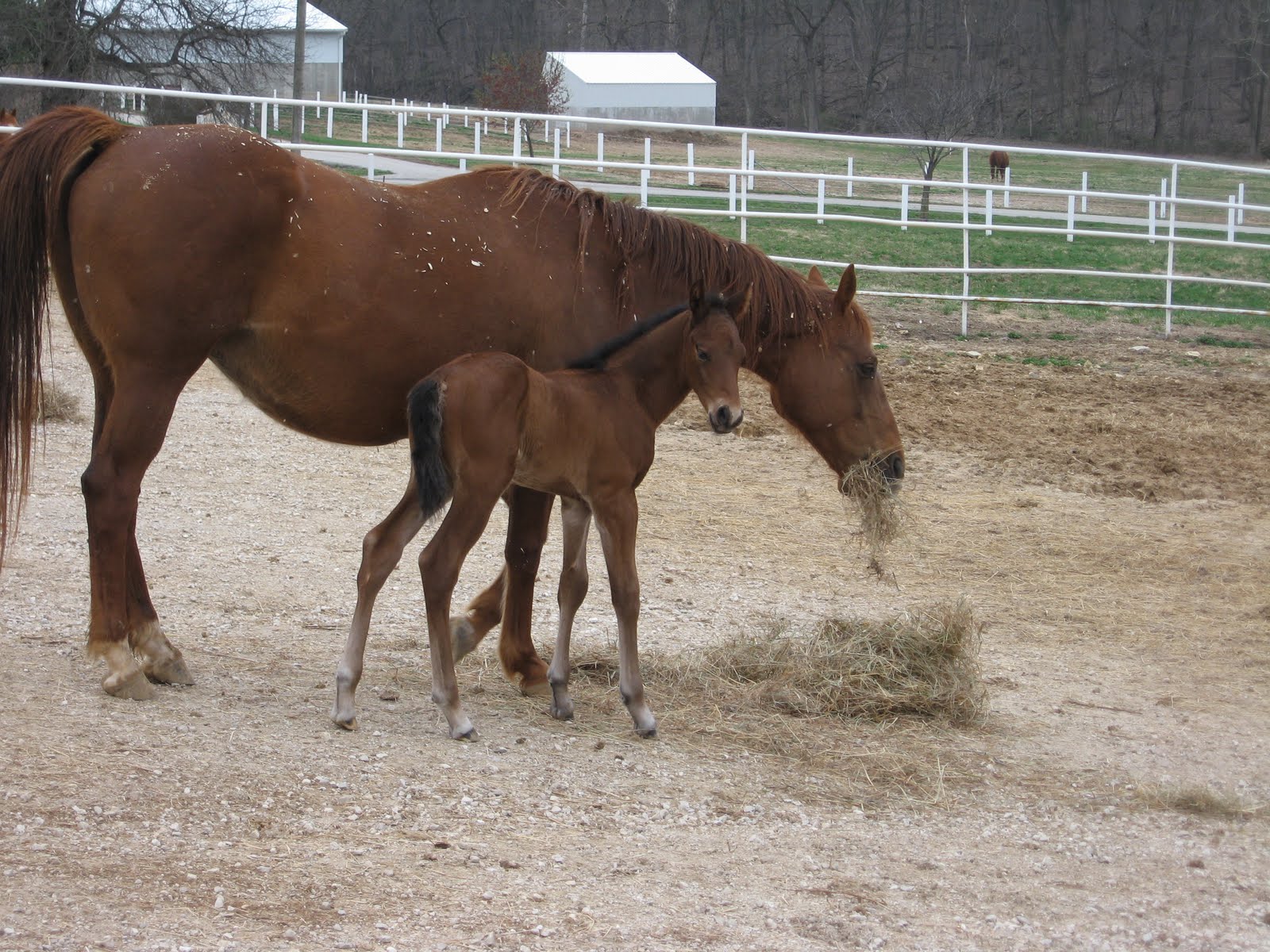
Dottie's foal is growing and doing great but he still needs a name. I know, its totally unacceptable that he doesn't have a name yet, but a name is something that stays with you the rest of your life and when you're special like this little guy, it has to be a good one.


He is a month old now and we took he and his mom to the vet yesterday since she was teasing very strong on Wednesday evening. When we unloaded the foal, the vet techs commented on how stout he was for his age. Good genetics supported by good milk from mom and a little extra support from Purina Strategy GX - Professional Formula Horse Feed is doing the trick! Mom is eating 10 lbs of Strategy, 15 lbs of Coastal Berumagrass hay, 6-7 lbs of alfalfa hay every day and the "little guy" is nursing mom and eating right at 1 lb of Strategy GX since he is 1 month old now and he nibbles the alfalfa and grass hay as well. We're in a drought down in south Texas so grazing is more about roaming around and not so much about nutrition.


The vet ultrasounded Dottie when we arrived yesterday, finding a 40 mm folicle on one ovary and a 20 mm folicle on the other so she will be bred today and should ovulate by Saturday which would be perfect. We are breeding Dottie back to this baby's sire, so we will have three in a row, full siblings. Hopefully, soon we'll have a name for this little guy. Coming up with a registered name is easier than the barn name for me. I'll entertain any suggestions you may have, maybe we can get him a name before he gets started under saddle!

Wednesday, April 13, 2011

The Legends of Ranching

Some might be wondering why we have information about a horse auction called "The Legends of Ranching Sale" on our website. The horses that we raise here at the farm stay here to work with us, developing new products, and then go to individuals that would like to purchase them. For the past several years Purina has been actively involved with this sale and has had horses in the sale. We send 4 long yearlings to Colorado State University in late summer/fall each year. Students train the horses to work under saddle, and the horses are then sold in an auction the following spring, which is the Legends Sale. The sale has many of the top ranches in the country offering horses for sale. You can see more information here; http://equinescience.colostate.edu/content/view/125/75/ We are excited for the opportunity to be involved with this event, and enjoy the chance to show off some of the horses that are bred and raised here at Longview. The sale is covered by Superior Livestock Auctions, which gives everyone the chance to place bids over the phone or on the internet. Superior's site is; http://www.superiorlivestock.com/ Keep checking back, there will be more posts to follow as we get closer to the sale and I will post pictures of the horses and the sale!

Tuesday, April 12, 2011

Manufacturing research feeds


I had a fun and productive day yesterday with Kent Lanter and Steve Furst at our Mulberry horse feed mill in central Florida. Kent and I traveled there to oversee the manufacturing of a new feed that is being shipped out for a large research project. Kent is our "mad scientist" so to speak that helps us on the process research side and to figure out how all the different ingredients us nutritionists want to put in a feed will actually end up as something a horse will eat! Steve is the plant manager with a huge amount of experience and always runs a great mill with a crew that is willing to work with us on new feeds and designs.


I always like spending time in our mills and it makes me proud to see how things are running smoothly- from ingredient testing, to mixing, pelleting, blending, packing, etc. Its nice to work with all our dedicated employees that are ensuring the feed is made correctly and with our high quality standards.


We made three different rations yesterday, 30 tons of feed in all that is now enroute to its research location. I wish I could tell you what it was, but of course, that is top secret while we are in the development phase. I can tell you this- if this product performs as expected, it won't hit the market until 2012 at the earliest! It takes time to do good research and develop new and innovative products that are good for the horse. A lot of formulating, testing, retesting, field trials and more.


So enjoy the pics of our Mulberry mill at sunrise and all the feed ready to load on the trucks! That's all you're getting for now....


And I have to give a shout out to Dr. Kelly Vineyard. This is actually a research project that she has been working on- and she was not able to make it to the mill because she is officially on maternity leave! Baby Owen Robert Vineyard was born last Tuesday, April 5th and the whole family is doing very well.


Have a great day!

Thursday, April 7, 2011

Nine is Fine!


Number nine out of ten expected foals arrived yesterday, he got to go out and explore the world this morning. (He thought the human with the camera was the most interesting thing apparently) Our foals get 24 hours with mom in a stall before their first turnout. It gives the mare and foal a chance to really bond, lets the foal get plenty of milk without having to chase mom, and gives their eyes a chance to start adjusting to being in the daylight. This gives them the best possible chance to get a healthy start before being exposed to all of the good stuff in the real world!


One more foal to go and all we have to do is get the mares bred back for next year!


Friday, April 1, 2011

New Product Release for Ultium Growth!!!


It is with great pleasure, that we announce the release of two new Ultium Growth products: Ultium Growth- Black Foal and Ultium Growth- Chestnut Foal. Through years of nutritional research, we have finally determined how to feed broodmares to influence foal coat genetics and ensure your foal is born in your desired color! See the pictures below of our babies, each a chestnut (yes I know some of you Quarter Horse people would want us to call this sorrel) and a black foal, each born from a mare feeding the appropriate “color marking” feed. Stay tuned to this blog for more information on when these feeds will be available in your area. And yes, we are working on more Ultium Growth color feeds- especially for grey, bay, palamino and even pinto horses.


PS. April Fools!


Thursday, March 31, 2011

Avalanche!


We are getting into the thick of it now, there are eight foals on the ground for us. We have two more mares that are due in the first part of April, so we might get a short break of checking mares all night! All are doing quite well so far, and they are a good looking bunch! The pictures I have plugged in are two foals that are two weeks old now. We are working on getting our mares bred back for next year and it is a lot of work! Our oldest foals are already starting to consume Ultium Growth, and they love it!

Tuesday, March 29, 2011

Mid-Atlantic Nutrition Conference

Last week, I traveled to the Mid-Atlantic Nutrition Conference in Timonium, MD. It was great to see a lot of my colleagues in the horse nutrition world and they had a wonderful line-up of speakers.


The joke of the day was that many talks seemingly revolved around trying to "kill" horses! The topics were as follows:

Laminitis- presented by Dr. Teresa Burns from The Ohio State University Vet School

Ionophore Toxicity in Horses- by Dr. Ken Marcella

Mycotoxins in Horses - by Dr. Lon Whitlow from North Carolina State University

Fescue Toxicity in Horses- by Dr. Rhonda Hoffman of Middle Tennessee State University

Toxic Plants- by Dr. Anthony Knight- Colorado State University

Young Horse Nutrition and Overfeeding- by Dr. Josie Coverdale from Texas A&M

Nutrient Management Update- by Ann Swinker from Penn State University

So, as you can see, a lot of discussion about what is bad for horses, complications of feeding horses wrong or bad things and what to do about it. The most fascinating talk for me was the Toxic Plants talk by Dr. Anthony Knight. We also ate lunch together and it was great to be able to ask him questions about poisonous plants and which ones pose more of a risk than others. His take home message was two-fold: 1) Dose Matters! There can be a big difference in a horse eating a little bit of a toxic plant versus a whole pasture full of something poisonous 2) Water hemlock is THE MOST POISONOUS plant to horses. It only takes 6-8 oz of the root to kill a 1000 lb horse. Scary.... I had read Dr. Knight's books on poisonous plants, but it was wonderful to see his talk in person and get a refresher course. We specifically chatted about creeping indigo, as it is native to south Florida and I've seen my horse grab mouthfuls of this toxic plant at horse shows before I could steer him away. Good to know this is one of the lesser toxic legumes and my horse isn't about to go into convulsions!

If I were to give you one take-home message from each of the other talks, it would be this:

1) Laminitis- Remains devastating to the horse community, but cryotherapy (ice therapy) is very helpful in the acute stages for decreasing the inflammatory response. Its not always easy to implement, but get those hooves on ice as soon as possible and keep it up as your vet recommends.

2) Ionophore toxicity in horses- make sure your feed is manufactured in an ionophore free manufacturing system/plant such as our Feed Guard Model follows. To us at Purina, it is not worth the risk to our horses to make feed in a plant that has ionophores. Also, don't feed cattle feed to horses, as this is a common way horses get poisoned with ionophores.

3) Mycotoxins- again, you need to be informed on what you are feeding your horses and make sure the feed ingredients are tested for mycotoxins. Mycotoxins are naturally occurring molds that can be tested for. Every load of corn that goes into a Purina plant is tested for mycotoxins- if its not clean, it gets rejected. Again, Feed Guard helps to protect your horse from mycotoxin exposure.

4) Fescue Toxicity- this is not a new topic to horse owners, but important as a reminder all the same. Broodmares should not be maintained on endophyte positive fescue pasture, and if its unavoidable, the dopamine inhibitor Domperidone given during the last 20 days of gestation can help. If possible, only use endophyte free fescue in horse pastures.

5) Young Horse Nutrition/Overfeeding- rapid growth does not appear to increase the risk of OCD; it is the overall plane of nutrition and other factors of genetics and management that play contributory roles. Resist the temptation to rapidly decrease nutrient planes on young horses with OCD problems- they still require a BALANCED ration for growth.

6) Equine nutrient management- For those of you in the mid-atlantic states of MD, PA, NJ, etc. the regulations on manure management for large and small farms are in place and need to be learned about. Best management practices (BMPs) to minimize nutrient and sediment will need to be employed and it can be confusing figuring out where your farm fits in and what you need to do. Work closely with your ag-extension agent in your area for help.

Overall, it was a very educational day and good to spend time with colleagues and friends. If you would like more information and/or a copy of the proceedings from this conference, please visit: http://www.manc.umd.edu/ Have a great day!!