Monday, March 12, 2012

Utah Horse Trainers Challenge at the Utah Horse Expo

Every year about this time, Utah’s best horse trainers have just finished taking part in the Utah Horse Council Trainers Challenge.

This event pits four of the state’s top trainers, selected from an initial pool of applicants who are then whittled down to 10 semi-finalists, against each other to determine whose previously unbroken horse has shown the most development in 60 days. The winner is determined by a combined score of popular vote and judges’ decision. This year’s event culminated at the Utah Horse Expo, this past weekend in South Jordan, Utah.

In the fall before the trainers are selected, unbroken horses are bought and turned out to winter pasture. Come mid-January, the top four trainers draw for their horses and have 60 days to train them to compete in front of the judges and attendees at the Utah Horse Expo.

My job is to put together a proper feeding program that will ensure adequate nutrition for the animals’ growth and development, not to mention the hard work that they will be put through over the 60 days. I am always amazed at the skill and dedication these trainers put forth into this competition!

My favorite success story from last year was Zoey. Though she didn’t win the final competition, trainer Debbie Doneyson displayed remarkable progress during her 60 days with Zoey. Having arrived at Debbie’s farm underweight, Zoey showed dramatic change in her demeanor and body condition by the final competition.

Zoey’s diet needed to be carefully managed to meet her nutritional needs for growth and energy during the 60-day training program. I started Zoey off on free choice grass hay, Purina® Ultium® Growth horse feed and WellSolve® Well-Gel®. Debbie initiated a lot of the groundwork in the first month and when Zoey started putting on weight, we slowly added alfalfa to her diet and increased her workload. The high fat, high fiber diet really helped her put on muscle and improve her body condition so Debbie was able to progress to more advanced training techniques.

As you can see from these before and after photos, Zoey showed a great turnaround with Debbie’s careful training and a diet of Purina® Ultium® Growth horse feed and WellSolve® Well-Gel®. In fact, Debbie did such a great job with Zoey that a Purina employee fell in love with her during the show and purchased her for his farm in Idaho!

Before:


After:


I saw a lot of great progress on this year’s horses and it was exciting to see all of the hard work pay off. Did you make it to the Utah Horse Expo? What did you think about the Trainers Challenge?

About the Author: Yvette Connely is an animal nutrition specialist with Land O’ Lakes Purina Feed, where she oversees dealer account responsibilities and is an equine specialist for the state of Utah. Yvette has worked with Purina for 13 years, previously working as an equine nutrition specialist in Arizona. She has a B.S. degree in equine science from Colorado State University.

Saturday, February 25, 2012

Its a boy!

Snakey had her baby last night- here is a quick clip when he is a couple of hours old working on getting nursing figured out!


Friday, February 24, 2012

Is tonight the night?

We are once again on the brink of foaling season here at the research farm. I took a little video of "Snakey" when we checked her yesterday morning. I thought for sure we would have a baby this morning, but no such luck! It might be a long Friday evening, unless she decides to have it today.. In this video clip you can clearly see wax on her nipples which is usually a good indication of imminent foaling. I will be sure to put up a picture of her baby when it hits the ground!


Tuesday, February 21, 2012

Are extruded feeds easier for a horse to digest?

If you have ever fed a commercial dog food product, you know what an extruded feed looks like. Extrusion is simply the process of pushing a mix of heated feed ingredients through small holes under high pressure. You don’t see many extruded horse feeds these days, but there are some out there (two extruded Purina products are WellSolve W/C and Amplify). One of the biggest claims by manufacturers of extruded horse feed is that it is easier for horses to digest, therefore making it better for horses recovering from colic surgery. This is not exactly the case, and there's more to the story:


Purina Amplify, an extruded high-fat nugget


It is true that extrusion does increase digestibility of starch and protein as compared to certain un-processed ingredients. However, there is no strong science to back the notion than extrusion is better than other processing methods (such as pelleting) to increase digestibility. The 2007 NRC does make mention that “feeding a complete feed containing extruded ingredients was more effective at maintaining the body weight of old horses with low body condition when compared to a more traditional ration”. This statement refers to Dr. Les Bruer’s published research on Purina Equine Senior (back then, it contained Athlete, the extruded fat nugget utilized before Amplify). This is the only place in the NRC that extrusion is mentioned specific to a horse feed. The only other place it comes up is in a general discussion of the process and also in some studies looking at how different processing methods (including extrusion) affect digestibility of whole grains. The general conclusion of those studies was that the mechanical and heat treatment of certain feed ingredients (i.e. corn) through pelleting, extrusion, micronizing, or popping can increase the starch and protein digestibility as compared to un-processed ingredients. But there is no consistent evidence to show that one processing method utilizing heat is superior to any other. During the pelleting process, “raw” feed ingredients are subjected to both high temperature and moisture, a process which enhances digestibility of certain feed components. During extrusion, the final step after heat and moisture treatment is when the pellet expands as steam is released very rapidly due to a sudden drop in pressure. This creates the “puffed” physical appearance of an extruded feed. So in general terms, the primary difference between extrusion and pelleting is the final step of the process. Both processes improve the overall digestibility of raw feed ingredients as compared to whole grains, and there currently is no published evidence that one processing method is better than the other. So the decision as to whether a pelleted or extruded feed is more digestible should be made based on the formula and nutritional content of the feed itself (and the research behind that feed) and not solely on the processing method alone.

Bottom line: Processed feeds can be easier to digest than unprocessed feeds, especially for horses with poor teeth or that have gastrointestinal health issues, but there are no proven advantages of one specific processing method over another.

Thursday, January 19, 2012

No break in R&D for the new year!


We are trying to get readjusted after the completion of our exercise physiology test in December. After our last data collection day we moved all of the exercise horses out to pasture for a well deserved break. Our broodmares and open mares have all been moved into the barns in preparation for foaling. We started our artificial lighting program for breeding season the second week in January and are almost ready to go!


Last week we started a long series of palatability trials with our taste testing horses. You can see in the picture some measured out ingredients we are testing to evaluate preference with our horses. They are offered two types of feed at feeding time, both feeds are the same except for one different ingredient. All they need to do is tell us which one they prefer by the amount consumed.


Thursday, January 5, 2012

Dedication to Animal Nutrition


Today marks the 31st anniversary of Barb Tremayne's employment with Purina. Barb is a registered veterinary technician who joined the company in 1981. Barb began her career with Purina helping to develop products such as dewormers and fly sprays for Ralston Purina's Health Industries division. She then moved to Veterinary Services, where she remains today. It is difficult to describe all that she does in a day, because she is definitely our "jack of all trades", our own Miss Fix-it. She does it all, from assisting me in taking care of the animals here at the research farm to performing laboratory analysis on samples collected from all of our research units. She also does all the ordering, inventory and equipment maintenance, along with countless other tasks through the day. Barb is a huge asset to our operation and we couldn't do what we do without her.


In today's world loyalty, passion and dedication are often lacking in the workplace. Barb's committment to helping make the lives of animals better through nutrition is a great example for us all to follow. Thanks Barb for all that you do!

Tuesday, January 3, 2012

Five Horse Nutrition New Year's Resolutions

Happy New Year! One again, it is time to make those New Year’s resolutions that inspire us with new hope for the New Year. Sure, most resolutions get broken before the month of January is even through, but I still think that making resolutions is a good exercise that encourages us to set concrete goals and work towards improving some area of our lives. Thanks to this inspiring tradition, I have come up with a list of New Year’s resolutions that relate to feeding horses. Perhaps you already do many of the things on this list; if not, hopefully there is one resolution that you may consider implementing in 2012.

1) Weigh (in pounds or kilograms) all feed (concentrates and hay) offered to the horse.

If you really want to know that your horse is getting all the nutrition he requires, the first and most important step is to know exactly how much he is eating. Get an inexpensive fish scale that can easily be used in the feed room. To weigh a “scoop” of concentrate, get a plastic grocery bag and put one full scoop of feed in it. Hang the bag of feed on the scale, and you will know exactly what one scoop weighs. Be sure to do this with all of your feeds, because all feeds have a different density and will weigh slightly different. Pellets, for example, typically weigh more per quart than textured mixes (i.e. sweet feeds). For hay, you can determine the weight of an average flake using the same method with a larger trash bag. Make a note of these weights for easy reference.

2) Monitor bodyweight on a monthly basis.

This is so easy to do and can be a crucial part of your horse’s health maintenance program. Not only will it help you determine the right amount of feed to feed your horse, but it will also help with determining the correct medication dosages (i.e. dewormer) and potentially alert you to certain medical conditions (sudden weight gain or loss can be a sign of a problem). You can do this with either a specially designed weight tape for horses or with long (non-stretchy) rope or string to measure both the heartgirth and body length in inches. Use the equation "Weight (lbs.) = Girth2 (in.) x length (in.) / 330", or go here for a handy online calculator from The Horse to determine the weight from these measurements. Keep in mind that daily weight fluctuations up to 50 lbs. are normal in the average-size horse, but anything more than that should be addressed. Personally, I do this at the first of every month and make a note of it on my barn calendar. I have a senior horse that is a hard keeper, and keeping track of his weight is especially important so that I can make necessary adjustments to his diet based on the season, his workload, and his current bodyweight.

3) Get your hay analyzed.

This is so easy to do, but many people feel like it must be too complicated or they won’t know how to interpret the analysis. However, if you buy hay in bulk, it is very important to have a general idea of the nutritional value of your hay. This way, you can determine if your hay quality is truly appropriate for your horse and how to choose a concentrate feed that best complements your hay. I use and recommend the services of Equi-Analytical Laboratories for forage testing, but there are many others. Equi-Analytical has clear instructions on their website on how to take and submit a representative forage sample. If you need assistance with interpretation, there is some information on their website that can help. In addition, you can contact your local equine extension agent, a private nutrition consultant, or your local Purina Equine Specialist with any questions you may have.

4) Eliminate unnecessary supplements.

Does your feed room shelf look like this?
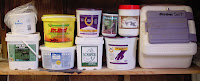
If so, you are spending way too much money on supplements that are probably not doing what you think they are doing. The equine supplement industry in the U.S. is not regulated, meaning that manufacturers can basically make any claim they want about their products without having any data or proof to back it up. Unfortunately, this makes it extremely difficult for the average owner to determine what it true and what is simply marketing hype. Many horses will not need any supplements at all, as long as they are fed a balanced ration that meets their nutrient requirements and provided free-choice access to salt. But there are some horses that will benefit from some type of supplement, such as electrolytes, a forage balancer vitamin/mineral mix, and/or a joint supplement. The key is to find a reputable manufacture that consistently produces a quality product that is backed by research. Unfortunately, these quality supplements are few and far between. It is definitely a “buyers beware” market, and the best plan is to put your money into good quality feed products that will minimize or even eliminate the need for supplements in the first place!

5) Evaluate your overall feeding program and switch your horse to a more appropriate feed product if necessary.

Do you feed the same “10% pellet” that your grandpa used to feed? Have you been feeding the same product for the past 5 years or more? Do you feed the same feed to all horses on your property? If you have not evaluated your feeding program recently, there is no time like the present. With all of the new research and feeding technologies we have been coming out with at Purina over the past few years, it is likely that there is a new product out there that may fit your horse’s needs better that what you are currently feeding. Take a good look at the products available at your local Purina dealer and check out Purina’s website to familiarize yourself with what is currently available. Read the feeding instructions on the bag to be sure you are feeding the product correctly. Talk to your dealer or contact us if you have any questions about your feeding program. We’re here to help you make the right choices for your specific situation.